
{{ js_integration_head_start() }} {{ head_elements() }} {{ head_css() }} {{ head_js() }} {{ js_integration_head() }} {{ include_default_custom_css(content.include_default_custom_css, template_meta.include_default_custom_css, domain_settings.include_default_custom_css) }} {{ include_attached_css(content_group.attached_stylesheets or domain_settings.attached_stylesheets, content.enable_domain_stylesheets, template_meta.enable_domain_stylesheets, theme_meta.enable_domain_stylesheets, domain_settings.enable_domain_stylesheets) }} {{ include_attached_css(template_meta.attached_stylesheets, content.enable_layout_stylesheets) }} {{ include_attached_css(content.attached_stylesheets) }} {{ require_attached_js(template_meta.attached_js) }} {% if not suppress_hubdb_hreflang %} {% endif %}
Skip to content
English
  • There are no suggestions because the search field is empty.

Practicing again to improve

The power of training lies in repetition. Nothing stops you from redoing a scenario as many times as you like, and it's actually recommended.

Relaunching a scenario

From your scenario library, simply reopen the scenario and start it again. Each run creates a new simulation, with its own debrief.

Comparing your runs

All your simulations are kept in your session history. By reopening your successive debriefs, you can see concretely what improves from one attempt to the next: it's very motivating, and far more telling than a single isolated score.
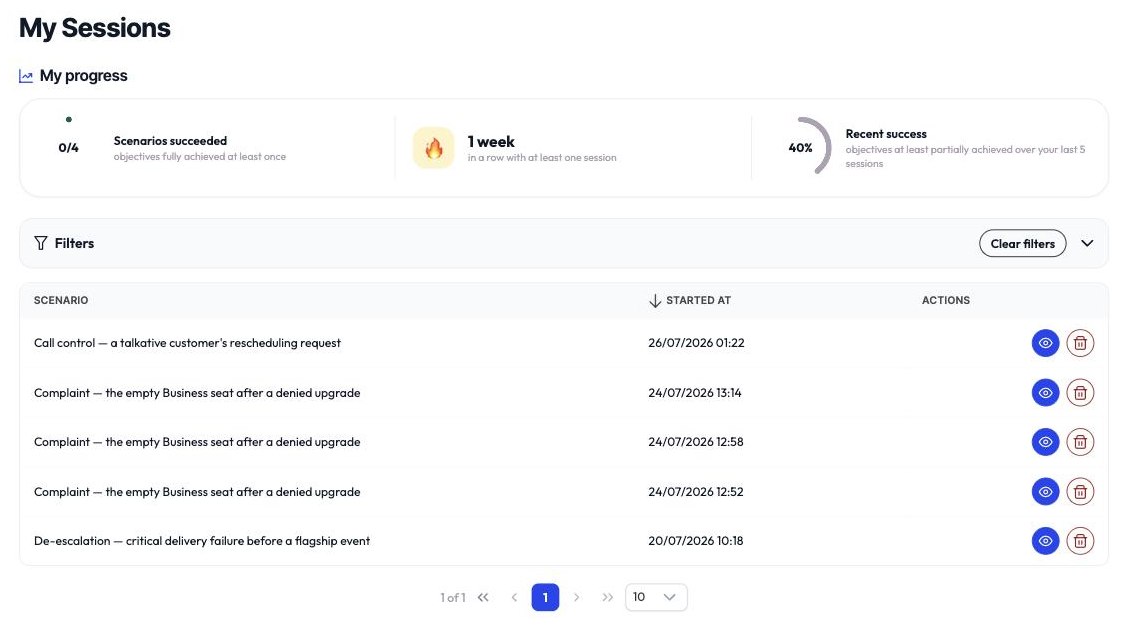
My Sessions: several runs of the same scenario

Our advice

After a simulation, pick one area for improvement from your debrief, then redo the scenario focusing only on that. One objective at a time: it's the most effective way to progress.

See Improving from one session to the next.