
{{ js_integration_head_start() }} {{ head_elements() }} {{ head_css() }} {{ head_js() }} {{ js_integration_head() }} {{ include_default_custom_css(content.include_default_custom_css, template_meta.include_default_custom_css, domain_settings.include_default_custom_css) }} {{ include_attached_css(content_group.attached_stylesheets or domain_settings.attached_stylesheets, content.enable_domain_stylesheets, template_meta.enable_domain_stylesheets, theme_meta.enable_domain_stylesheets, domain_settings.enable_domain_stylesheets) }} {{ include_attached_css(template_meta.attached_stylesheets, content.enable_layout_stylesheets) }} {{ include_attached_css(content.attached_stylesheets) }} {{ require_attached_js(template_meta.attached_js) }} {% if not suppress_hubdb_hreflang %} {% endif %}
Skip to content
English
  • There are no suggestions because the search field is empty.

What is a Face Up debrief?

The debrief is the moment your simulation becomes real learning. Right after the exchange, Face Up prepares personalized feedback on how you handled it.

Feedback, right after your simulation

As soon as the conversation ends, your debrief is prepared automatically and appears within moments. It analyzes your exchange, what you said and the way you said it, to give you useful, concrete feedback.
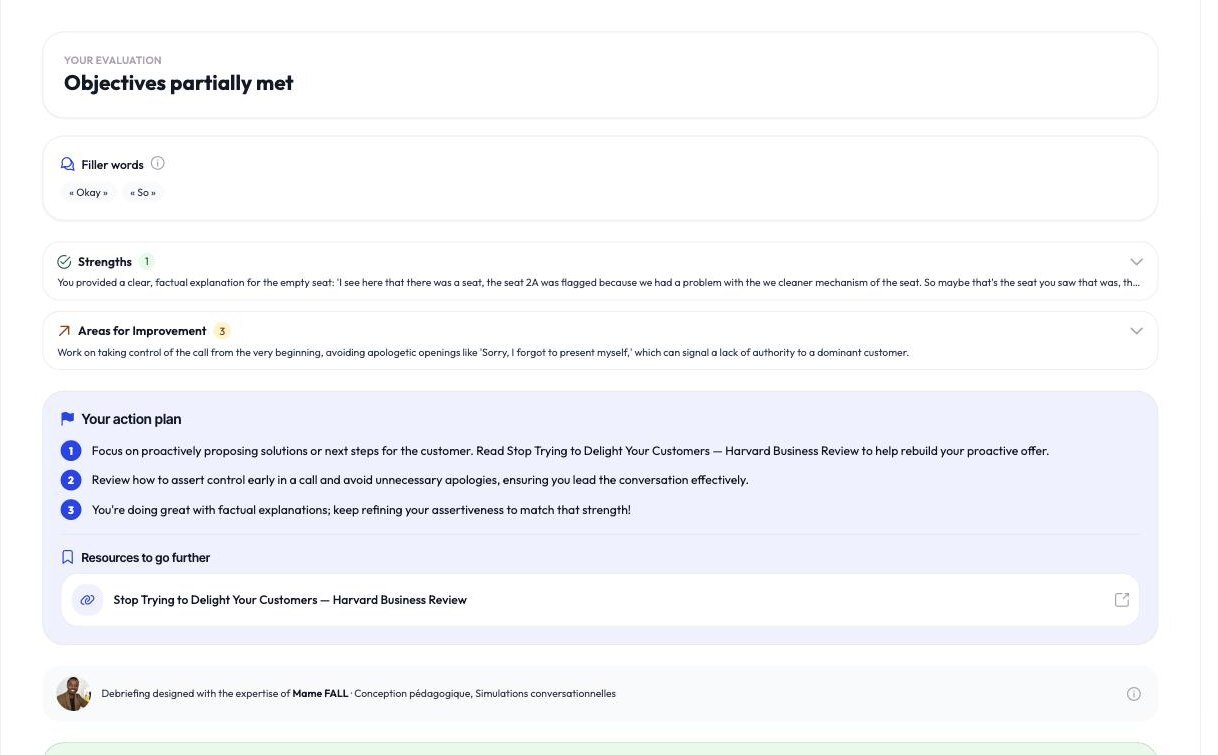
A debrief shown right after a simulation

Delivered by an expert

Your debrief is presented to you by an expert: a figure who gives the feedback a professional identity, as if a trainer from the field were reviewing your performance. It's that perspective that makes the feedback more meaningful.

The debrief is designed with the expertise of a subject-matter expert

What you'll find in it

A debrief highlights your strengths and your areas for improvement, with concrete observations drawn from your exchange. Depending on the scenario, it may also give you a numeric marker of your performance.

For the detail, see Reading your debrief and Understanding your score.