
{{ js_integration_head_start() }} {{ head_elements() }} {{ head_css() }} {{ head_js() }} {{ js_integration_head() }} {{ include_default_custom_css(content.include_default_custom_css, template_meta.include_default_custom_css, domain_settings.include_default_custom_css) }} {{ include_attached_css(content_group.attached_stylesheets or domain_settings.attached_stylesheets, content.enable_domain_stylesheets, template_meta.enable_domain_stylesheets, theme_meta.enable_domain_stylesheets, domain_settings.enable_domain_stylesheets) }} {{ include_attached_css(template_meta.attached_stylesheets, content.enable_layout_stylesheets) }} {{ include_attached_css(content.attached_stylesheets) }} {{ require_attached_js(template_meta.attached_js) }} {% if not suppress_hubdb_hreflang %} {% endif %}
Skip to content
English
  • There are no suggestions because the search field is empty.

A quick tour of the interface

You don't need a full manual to get started: the essentials of your learner space live in two places.

The Face Up learner workspace

The sidebar

  • The scenario library: all the scenarios made available to you. It's your starting point to launch a simulation.
  • Session history: the list of your past simulations, where you find every debrief.
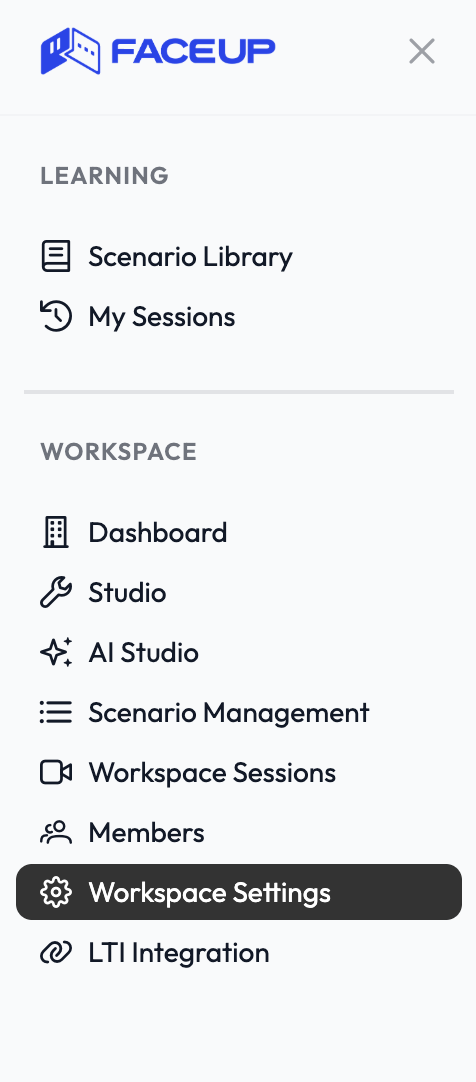
The side menu: Scenario Library and My Sessions

Switching spaces

If you belong to several groups, you can switch between them with a selector. The scenarios and history shown depend on the space you select.

Where are my debriefs?

Each debrief is tied to the simulation that produced it. You reach it right after the simulation, then at any time by reopening the session from your history.